

Antioxidant BHT 264
CAS:128-37-0
Purity:99%
Contact Now
We will contact you as soon as possible
Your Location:Home >Products >Intermediates >56211-40-6
Product Details
|
Diuretics |
Diuretics are drugs mainly acting on the kidneys to increase the excretion of water and electrolytes, and increase urine output. Their potency can be divided into: 1. potent diuretics (loop diuretics): including furosemide, bumetanide, ethacrynic acid. 2. Middle efficiency diuretics include: thiazide diuretics, such as hydrochlorothiazide, bendroflumethiazide and so on. 3. Inefficient diuretics include: retention of potassium diuretics spironolactone, triamterene and carbonic anhydrase inhibitor acetazolamide and the like. Potent diuretics effect on medullary loop ramus crude segment medulla,they inhibit reabsorption of active chlorine, followed by inhibiting sodium reabsorption, and play a strong diuretic effect. Torasemide is a potent diuretic, its mechanism of action is similar to furosemide, it has no effect on the proximal tubules, it does not cause an increase in the discharge of potassium. This product increase renal volume and sodium excretion is dose-dependent , it does not affect the calcium and potassium excretion, excretion and metabolism have no association with renal function, large doses have no significant toxicity. Sort diuretic strength by: bumetanide> torasemide> piretanide> furosemide. It is useful in the treatment of acute and chronic renal failure and essential hypertension. Adverse reactions of torasemide are similar to furosemide ,common adverse reactions are headache, dizziness, weakness, nausea, muscle spasms, but it produces lesser extent of potassium loss ,it has no effect on uric acid, blood glucose and lipid . The above information is edited by the lookchem of Tian Ye. |
|
Manufacturing Process |
In a 100 ml three-necked flask equipped with magnetic stirrer, condenser, thermometer and dropping funnel 3-sulfonylchloride-4-chloropyridine (10 g, 1 eq., 46.7 mmoles) was suspended in t-butyl-methyl ether (MTBE) (30 ml) at room temperature. Ammonium hydroxide, 25% solution (13.5 ml, 2.13 eq.) was dropped into the suspension in a rate such that the temperature is allowed to increase to 22°-26°C, this temperature was maintained until all the ammonium hydroxide was added. The suspension was then to cooled to room temperature and was stirred for 1 h. The pH of the suspension was adjusted to 80.1 by the addition of a few drops of ammonium hydroxide, 25% solution. The suspension was filtered and washed with water (2 times 10 ml) and the wet product (8 g) dried at 40°C, under the 1 mm Hg vacuum. 3-Sulfonamide- 4-chloropyridine was isolated in 74.4% yield, 6.7 g. A mixture of 0.01 moles of 3-sulfonamido-4-chloropyridine, 0.02 mole of 3- methylbenzylamine and 50 ml of dry ethanol was heated to reflux temperature for 9 h. After distillation of the ethanol the residue was taken up in an excess of diluted NaOH and the excess of amine was extracted by means of ether. The aqueous solution was then decolourized with charcoal and filtered, and the filtrate was neutralized with acetic acid. The precipitated product was separated and purified by crystallization from a mixture of water and acetone.The 3-sulfonamido-4-(3-methylbenzyl)amino-pyridine crystallized in the form of beige coloured cristals having a melting point of 184°-186°C. 0.01 mole of 3-sulfonamido-4-(3-methylbenzyl)amino-pyridine was reacted with 0.015 mole of isopropylisocyanate in the presence of 0.02 mole of triethylamine and of 20 ml of dichloromethane, at room temperature for 20 h. After evaporation under vacuum, the residue was taken up in an excess of diluted Na2CO3, filtered off and acidified by means of acetic acid. After precipitation of the product it was filtered and washed several times with ice cold water. The 3-isopropylcarbamoylsulfonamido-4-(3-methylbenzyl)amino_x0002_pyridine (Torsemide) showing as a white powder, has a melting point of 147°- 149°C. |
|
Therapeutic Function |
Diuretic |
|
Biochem/physiol Actions |
Torsemide is a loop diuretic of the pyridine-sulfonylurea class with antialdosteronergic properties and inhibitor of the Na+/K+/2Cl- carrier system. |
|
Drug interactions |
Potentially hazardous interactions with other drugs Analgesics: increased risk of nephrotoxicity with NSAIDs; antagonism of diuretic effect with NSAIDs. Anti-arrhythmics: risk of cardiac toxicity with anti-arrhythmics if hypokalaemia occurs; effects of lidocaine and mexiletine antagonised. Antibacterials: increased risk of ototoxicity with aminoglycosides, polymyxins and vancomycin; avoid concomitant use with lymecycline. Antidepressants: increased risk of hypokalaemia with reboxetine; enhanced hypotensive effect with MAOIs; increased risk of postural hypotension with tricyclics. Antiepileptics: increased risk of hyponatraemia with carbamazepine. Antifungals: increased risk of hypokalaemia with amphotericin. Antihypertensives: enhanced hypotensive effect; increased risk of first dose hypotensive effect with alpha-blockers; increased risk of ventricular arrhythmias with sotalol if hypokalaemia occurs. Antipsychotics: increased risk of ventricular arrhythmias with amisulpride or pimozide (avoid with pimozide) if hypokalaemia occurs; enhanced hypotensive effect with phenothiazines. Atomoxetine: hypokalaemia increases risk of ventricular arrhythmias. Cardiac glycosides: increased toxicity if hypokalaemia occurs. Cytotoxics: increased risk of ventricular arrhythmias due to hypokalaemia with arsenic trioxide; increased risk of nephrotoxicity and ototoxicity with platinum compounds. Lithium: risk of toxicity. |
|
Metabolism |
Torasemide is metabolised by the cytochrome P450 isoenzyme CYP2C9 to three inactive metabolites, M1, M3 and M5 by stepwise oxidation, hydroxylation or ring hydroxylation. The inactive metabolites are excreted in the urine. |
|
Definition |
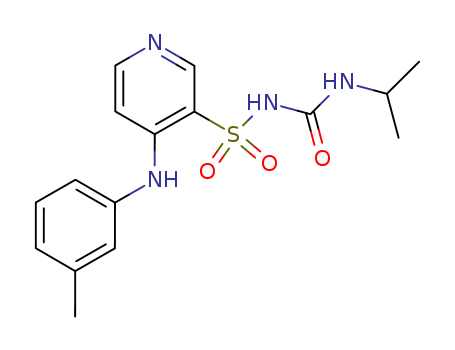
ChEBI: An N-sulfonylurea obtained by formal condensation of [(3-methylphenyl)amino]pyridine-3-sulfonic acid with the free amino group of N-isopropylurea. |
|
Brand name |
Torasemide is INN and BAN;Unat;Toradiur. |
InChI:InChI=1/C16H20N4O3S/c1-12(2)10-18-16(21)20-24(22,23)15-11-17-9-8-14(15)19-13-6-4-3-5-7-13/h3-9,11-12H,10H2,1-2H3,(H,17,19)(H2,18,20,21)
A method for the preparation of crystal ...
A method for the preparation of crystal ...
A process for preparing torsemide or sal...
The present invention relates to a new p...
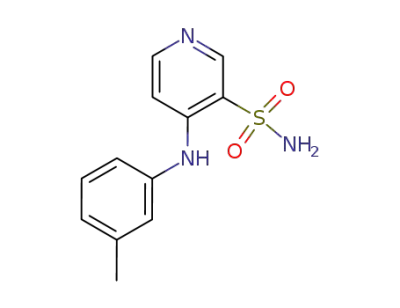
3-sulfonamido-4-(3'-methylphenyl) aminopyridine

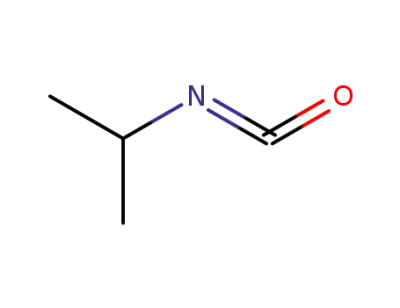
Isopropyl isocyanate

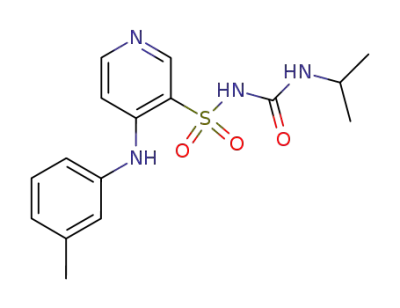
torasemide
| Conditions | Yield |
|---|---|
|
3-sulfonamido-4-(3'-methylphenyl) aminopyridine; Isopropyl isocyanate;
With
potassium carbonate;
In
diethylene glycol dimethyl ether; water;
at 65 - 70 ℃;
for 0.583333h;
With
acetic acid;
In
diethylene glycol dimethyl ether; water;
at 20 - 25 ℃;
for 3h;
pH=5.3 - 5.7;
|
96.5% |
|
3-sulfonamido-4-(3'-methylphenyl) aminopyridine; Isopropyl isocyanate;
With
sodium hydroxide;
In
acetone;
at 20 - 30 ℃;
With
acetic acid;
In
water; acetone;
at 20 - 25 ℃;
for 0.25h;
pH=5.3 - 5.7;
|
96% |
|
3-sulfonamido-4-(3'-methylphenyl) aminopyridine; Isopropyl isocyanate;
With
sodium hydroxide;
In
acetone;
at 20 - 30 ℃;
With
acetic acid;
In
water; acetone;
at 20 - 25 ℃;
for 0.25h;
pH=5.5;
|
96% |
|
3-sulfonamido-4-(3'-methylphenyl) aminopyridine;
With
potassium carbonate;
In
diethylene glycol dimethyl ether; water;
at 65 - 70 ℃;
for 0.25h;
Isopropyl isocyanate;
In
diethylene glycol dimethyl ether; water;
at 65 - 70 ℃;
for 0.333333h;
With
acetic acid;
In
H20; diethylene glycol dimethyl ether;
at 20 - 25 ℃;
for 3h;
pH=5.5;
|
96.5% |
|
3-sulfonamido-4-(3'-methylphenyl) aminopyridine; Isopropyl isocyanate;
With
potassium carbonate;
In
DMF (N,N-dimethyl-formamide); water; acetone;
at 55 - 60 ℃;
for 0.5h;
With
acetic acid;
In
DMF (N,N-dimethyl-formamide); water; acetone;
at 20 - 25 ℃;
for 0.25h;
pH=5.3 - 5.7;
|
95.7% |
|
3-sulfonamido-4-(3'-methylphenyl) aminopyridine;
With
potassium carbonate;
In
DMF (N,N-dimethyl-formamide); water; acetone;
at 55 - 60 ℃;
for 0.5h;
Isopropyl isocyanate;
In
DMF (N,N-dimethyl-formamide); water; acetone;
at 55 - 60 ℃;
With
acetic acid;
In
DMF (N,N-dimethyl-formamide); H20; acetone;
at 20 - 25 ℃;
for 0.25h;
pH=5.5;
|
95.7% |
|
3-sulfonamido-4-(3'-methylphenyl) aminopyridine; Isopropyl isocyanate;
With
potassium carbonate;
In
DMF (N,N-dimethyl-formamide);
at 55 - 65 ℃;
for 0.5h;
With
acetic acid;
In
DMF (N,N-dimethyl-formamide); water;
at 20 - 25 ℃;
pH=5.3 - 5.7;
|
94.9% |
|
3-sulfonamido-4-(3'-methylphenyl) aminopyridine; Isopropyl isocyanate;
With
potassium carbonate;
In
N,N-dimethyl acetamide; water;
at 65 - 70 ℃;
for 0.833333h;
With
acetic acid;
In
N,N-dimethyl acetamide; water;
at 20 - 25 ℃;
pH=5.3 - 5.7;
|
94.4% |
|
3-sulfonamido-4-(3'-methylphenyl) aminopyridine;
With
potassium carbonate;
In
DMF (N,N-dimethyl-formamide);
at 60 - 65 ℃;
for 0.5h;
Isopropyl isocyanate;
In
DMF (N,N-dimethyl-formamide);
at 55 - 65 ℃;
With
acetic acid;
In
DMF (N,N-dimethyl-formamide); H20;
at 20 - 25 ℃;
for 1h;
pH=5.5;
|
94.9% |
|
3-sulfonamido-4-(3'-methylphenyl) aminopyridine;
With
potassium carbonate;
In
N,N-dimethyl acetamide; water;
at 65 - 70 ℃;
for 0.5h;
Isopropyl isocyanate;
In
N,N-dimethyl acetamide; water;
at 65 - 70 ℃;
for 0.333333h;
With
acetic acid;
In
H20; N,N-dimethyl acetamide;
at 20 - 25 ℃;
for 3h;
pH=5.5;
|
94.4% |
|
3-sulfonamido-4-(3'-methylphenyl) aminopyridine; Isopropyl isocyanate;
With
potassium carbonate;
In
DMF (N,N-dimethyl-formamide); water;
at 60 - 75 ℃;
for 0.5h;
With
acetic acid;
In
DMF (N,N-dimethyl-formamide); water;
at 20 - 25 ℃;
for 0.5h;
pH=5.3 - 5.7;
|
93.2% |
|
3-sulfonamido-4-(3'-methylphenyl) aminopyridine; Isopropyl isocyanate;
With
potassium carbonate;
In
water; dimethyl sulfoxide;
at 60 - 75 ℃;
for 0.833333h;
With
acetic acid;
In
water; dimethyl sulfoxide;
at 20 - 25 ℃;
pH=5.3 - 5.7;
|
93.5% |
|
3-sulfonamido-4-(3'-methylphenyl) aminopyridine;
With
potassium carbonate;
In
DMF (N,N-dimethyl-formamide); water;
at 70 - 75 ℃;
for 0.5h;
Isopropyl isocyanate;
In
DMF (N,N-dimethyl-formamide); water;
at 60 - 65 ℃;
With
acetic acid;
In
DMF (N,N-dimethyl-formamide); H20;
at 20 - 25 ℃;
for 0.5h;
pH=5.5;
|
93.2% |
|
3-sulfonamido-4-(3'-methylphenyl) aminopyridine;
With
potassium carbonate;
In
water; dimethyl sulfoxide;
at 70 - 75 ℃;
for 0.5h;
Isopropyl isocyanate;
In
water; dimethyl sulfoxide;
at 60 - 65 ℃;
for 0.333333h;
With
acetic acid;
In
H20; dimethyl sulfoxide;
at 20 - 25 ℃;
pH=5.5;
|
93.5% |
|
3-sulfonamido-4-(3'-methylphenyl) aminopyridine; Isopropyl isocyanate;
With
potassium hydroxide;
In
1-methyl-pyrrolidin-2-one;
at 20 - 25 ℃;
With
acetic acid;
In
diethylene glycol dimethyl ether; water;
at 20 - 25 ℃;
for 3h;
pH=5.3 - 5.7;
|
91.4% |
|
3-sulfonamido-4-(3'-methylphenyl) aminopyridine; Isopropyl isocyanate;
With
potassium hydroxide;
In
1-methyl-pyrrolidin-2-one;
at 20 - 25 ℃;
With
acetic acid;
In
1-methyl-pyrrolidin-2-one; water;
at 20 - 25 ℃;
for 3h;
pH=5.5;
|
91.4% |
|
3-sulfonamido-4-(3'-methylphenyl) aminopyridine; Isopropyl isocyanate;
With
potassium carbonate;
In
1,3-dimethyl-2-imidazolidinone; water;
at 60 - 75 ℃;
for 0.833333h;
With
acetic acid;
In
1,3-dimethyl-2-imidazolidinone; water;
at 20 - 25 ℃;
pH=5.3 - 5.7;
|
90.2% |
|
3-sulfonamido-4-(3'-methylphenyl) aminopyridine; Isopropyl isocyanate;
With
potassium hydroxide;
In
DMF (N,N-dimethyl-formamide); water;
at 0 - 5 ℃;
With
acetic acid;
In
DMF (N,N-dimethyl-formamide); water;
at 20 - 25 ℃;
for 3h;
pH=5.3 - 5.7;
|
90.2% |
|
3-sulfonamido-4-(3'-methylphenyl) aminopyridine; Isopropyl isocyanate;
With
potassium hydroxide;
In
DMF (N,N-dimethyl-formamide); water;
at 0 - 5 ℃;
With
acetic acid;
In
DMF (N,N-dimethyl-formamide); water;
at 20 - 25 ℃;
for 3h;
pH=5.5;
|
90.2% |
|
3-sulfonamido-4-(3'-methylphenyl) aminopyridine;
With
potassium carbonate;
In
1,3-dimethyl-2-imidazolidinone; water;
at 70 - 75 ℃;
for 0.5h;
Isopropyl isocyanate;
In
1,3-dimethyl-2-imidazolidinone; water;
at 60 - 65 ℃;
for 0.333333h;
With
acetic acid;
In
1,3-dimethyl-2-imidazolidinone; H20;
at 20 - 25 ℃;
pH=5.5;
|
90.2% |
|
With
triethylamine;
In
water; acetone;
Heating;
|

phenyl N-isopropylcarbamate
3-sulfonamido-4-(3'-methylphenyl) aminopyridine
torasemide
| Conditions | Yield |
|---|---|
|
phenyl N-isopropylcarbamate; 3-sulfonamido-4-(3'-methylphenyl) aminopyridine;
With
triethylamine;
In
water; acetone;
for 3h;
Heating / reflux;
With
sodium hydroxide;
In
water;
at 20 - 25 ℃;
With
sulfuric acid;
In
water; acetone;
at 50 - 55 ℃;
for 1h;
Product distribution / selectivity;
|
87.8% |
|
phenyl N-isopropylcarbamate; 3-sulfonamido-4-(3'-methylphenyl) aminopyridine;
With
sodium hydroxide;
In
water;
at 90 - 100 ℃;
for 5h;
With
sulfuric acid;
In
water;
at 20 - 70 ℃;
for 1h;
Product distribution / selectivity;
|
85% |
|
3-sulfonamido-4-(3'-methylphenyl) aminopyridine;
With
sodium hydroxide;
In
water;
at 20 - 35 ℃;
phenyl N-isopropylcarbamate;
In
water; acetone;
at 50 - 60 ℃;
for 20h;
With
sulfuric acid;
In
water;
at 15 - 50 ℃;
for 3h;
pH=7.0;
Product distribution / selectivity;
|
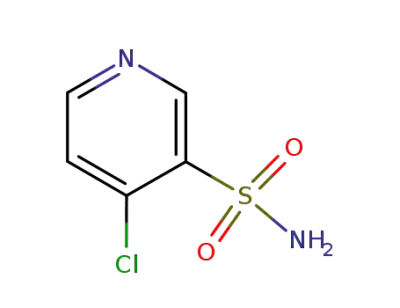
4-chloropyridine-3-sulphonamide

1-amino-3-methylbenzene
Isopropyl isocyanate
3-sulfonamido-4-(3'-methylphenyl) aminopyridine
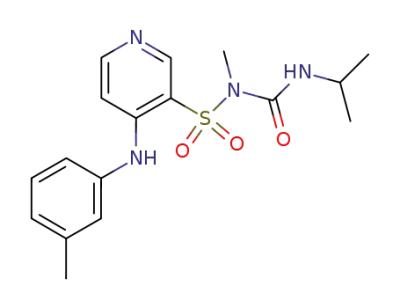
C17H22N4O3S
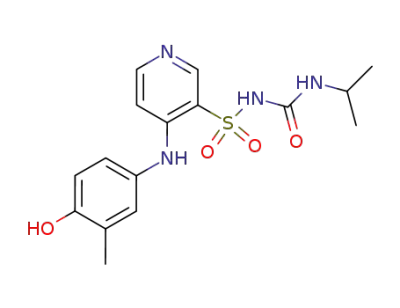
4-Hydroxytorsemide
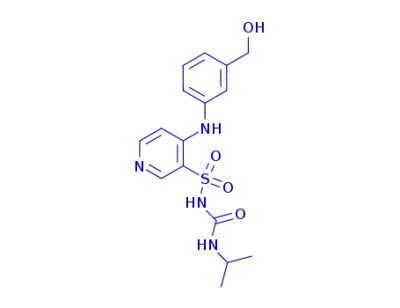
3-Hydroxymethyltorsemide