

Antioxidant BHT 264
CAS:128-37-0
Purity:99%
Contact Now
We will contact you as soon as possible
Your Location:Home >Products >Intermediates >668270-12-0
Product Details
|
Treatment of Type 2 diabetes |
Linagliptin acts to lower blood glucose levels by inhibiting the enzyme DPP-4, thereby preventing the degradation of the incretin hormones (glucagon-like peptide-1 [GLP-1] and glucose-dependent insulinotropic peptide) and attenuating postprandial glucose excursions. By selectively targeting DPP-4, linagliptin potentially causes a more physiologically based control of glucose-dependent postprandial glucose excursions and of fasting blood glucose, both of which are mediated by effects of glucose on insulin and glucagon secretion. An advantage of linagliptin is that since incretin-stimulated release of insulin is glucose dependent, linagliptin is associated with a low incidence of hypoglycaemia. Moreover, DPP-4 inhibitors have a low potential for drug-drug interactions (with the exception of saxagliptin, which is metabolized by cytochrome P450 [CYP] 3A4/5), are generally well tolerated and have minimal or neutral effects on bodyweight. |
|
Pharmacokinetics |
Linagliptin shows modest oral bioavailability, and it is rapidly absorbed. The maximum plasma concentration at steady state is reached on average 1.5 hours after administration of linagliptin 5 mg, once daily . Linagliptin half-life is 131 hours. No relevant food effects were observed on the absorption profile of linagliptin. Unlike other DPP-4 inhibitors, linagliptin excretion is not performed by the kidneys, but rather through the enterohepatic system. |
|
Definition |
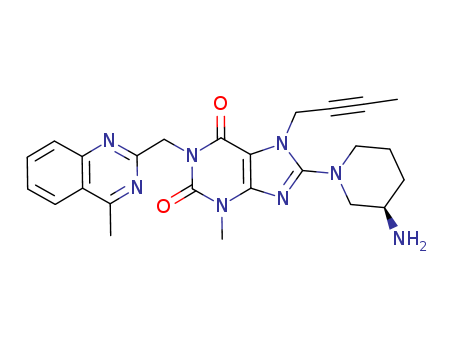
ChEBI: A xanthine that is 7H-xanthine bearing (4-methylquinazolin-2-yl)methyl, methyl, but-2-yn-1-yl and 3-aminopiperidin-1-yl substituents at positions 1, 3, 7 and 8 respectively (the R-enantiomer). Used for treatment of type I diabetes. |
|
Brand name |
Tradjenta |
|
Synthesis |
The synthesis of linagliptin began from commercially available 8-bromo-3-methylxanthine (171). Sequential alkylations of guanine derivative 171 at N-7 with butyn-2-yl bromide in the presence of N,N-diisopropylethylamine and N-1 with 2- (chloromethyl)-4-methylquinazoline (173) in the presence of potassium carbonate, yielded N1,N7-dialkylated xanthine 174 in 85% yield. This material was further condensed with (R)-3-Bocaminopiperidine (175) in the presence of potassium carbonate to give aminopurine dione 176 in 88% yield. Finally, the primary amine of 176 was liberated with trifluoroacetic acid in methylene chloride to produce linagliptin (XV) in 91% yield. |
|
Drug interactions |
Potentially hazardous interactions with other drugs Antibacterials: effects possibly reduced by rifampicin. |
|
Metabolism |
Minimal metabolism to inactive metabolites. Approximately 80% is eliminated in the faeces and 5% in the urine. |
InChI:InChI=1/C25H28N8O2/c1-4-5-13-32-21-22(29-24(32)31-12-8-9-17(26)14-31)30(3)25(35)33(23(21)34)15-20-27-16(2)18-10-6-7-11-19(18)28-20/h6-7,10-11,17H,8-9,12-15,26H2,1-3H3/t17-/m1/s1
The invention discloses a novel preparat...
The invention discloses a novel preparat...
The invention discloses a method for pre...
The invention relates to a preparation m...
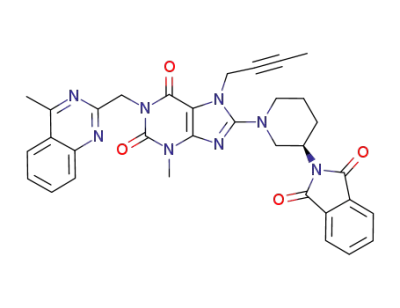
(R)-7-(but-2-yn-1-yl)-8-(3-(1,3-dioxoisoindolin-2-yl)piperidin-1-yl)-3-methyl-1-((4-methylquinazolin-2-yl)methyl)-3,7-dihydro-1H-purine2,6-dione

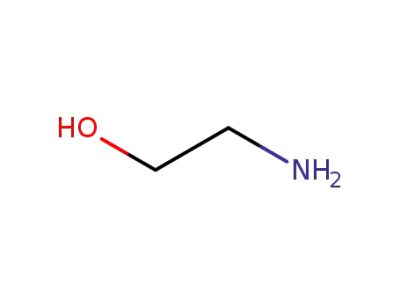
ethanolamine

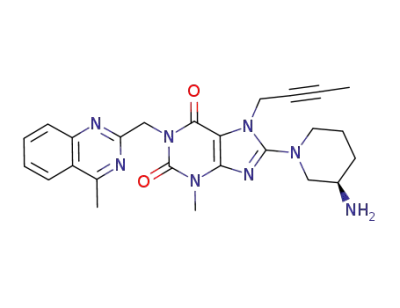
Linagliptin
(R)-N1-(1-(7-(but-2-yn-1-yl)-3-methyl-1-((4-methylquinazolin-2-yl)methyl)-2,6-dioxo-2,3,6,7-tetrahydro-1H-purin-8-yl)piperidin-3-yl)-N2-(2-hydroxyethyl)phthalamide
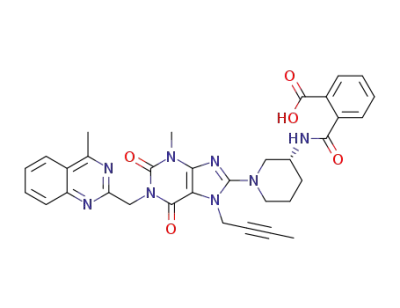
(R)-2-((1-(7-(but-2-yn-1-yl)-3-methyl-1-((4-methylquinazolin-2-yl)methyl)-2,6-dioxo-2,3,6,7-tetrahydro-1H-purin-8-yl)piperidin-3-yl)carbamoyl)benzoic acid
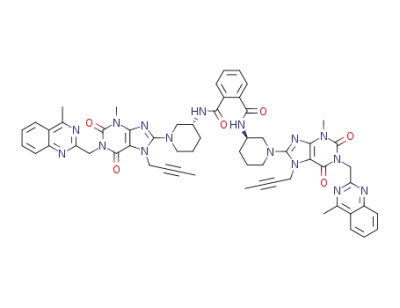
N,N'-bis((R)-1-(7-(but-2-yn-1-yl)-3-methyl-1-((4-methylquinazolin-2-yl)methyl)-2,6-dioxo-2,3,6,7-tetrahydro-1H-purin-8-yl)piperidin-3-yl)phthalamide
| Conditions | Yield |
|---|---|
|
With
water;
In
tetrahydrofuran;
at 60 ℃;
for 3h;
|
81.9% |
![1-[(4-methyl-quinazolin-2-yl)methyl]-3-methyl-7-(2-butyn-1-yl)-8-[(R)-3-(tert-butoxycarbonylamino)-piperidin-1-yl]-2,6-dioxo-2,3,6,7-tetrahydro-1H-purine](/upload/2026/7/dc156282-836b-4fd4-866d-0ce857b509bc.png)
1-[(4-methyl-quinazolin-2-yl)methyl]-3-methyl-7-(2-butyn-1-yl)-8-[(R)-3-(tert-butoxycarbonylamino)-piperidin-1-yl]-2,6-dioxo-2,3,6,7-tetrahydro-1H-purine
Linagliptin
| Conditions | Yield |
|---|---|
|
1-[(4-methyl-quinazolin-2-yl)methyl]-3-methyl-7-(2-butyn-1-yl)-8-[(R)-3-(tert-butoxycarbonylamino)-piperidin-1-yl]-2,6-dioxo-2,3,6,7-tetrahydro-1H-purine;
With
hydrogenchloride;
In
dichloromethane; water;
at 20 ℃;
for 3h;
With
hydrogenchloride;
In
ethanol; water;
at 35 ℃;
for 2h;
Temperature;
|
99.2% |
|
With
methanol; water;
Reflux;
Inert atmosphere;
|
96.8% |
|
With
methanol; water;
Inert atmosphere;
Reflux;
|
96.8% |
|
With
methanol; water;
Temperature;
Reagent/catalyst;
Inert atmosphere;
Reflux;
|
92.8% |
|
With
methanol; water;
Reagent/catalyst;
Reflux;
Inert atmosphere;
|
92.8% |
|
With
trifluoroacetic acid;
In
dichloromethane;
at 20 ℃;
for 1h;
|
91% |
|
With
trifluoroacetic acid;
In
dichloromethane;
at 5 - 20 ℃;
for 5h;
|
91% |
|
With
trifluoroacetic acid;
In
dichloromethane;
at 0 - 30 ℃;
for 12h;
|
90% |
|
1-[(4-methyl-quinazolin-2-yl)methyl]-3-methyl-7-(2-butyn-1-yl)-8-[(R)-3-(tert-butoxycarbonylamino)-piperidin-1-yl]-2,6-dioxo-2,3,6,7-tetrahydro-1H-purine;
With
trifluoroacetic acid;
In
dichloromethane;
at 20 ℃;
Inert atmosphere;
With
water;
In
1,2-dichloro-ethane;
|
88% |
|
With
trifluoroacetic acid;
In
dichloromethane;
at 10 - 20 ℃;
for 5h;
Concentration;
Reagent/catalyst;
Solvent;
|
87.2% |
|
With
formic acid; trifluoroacetic acid;
at 10 - 20 ℃;
|
87.3% |
|
With
trifluoroacetic acid;
In
dichloromethane;
at 10 ℃;
for 3h;
|
87.21% |
|
With
trifluoroacetic acid;
In
dichloromethane;
at 5 - 25 ℃;
for 4h;
Large scale;
|
82% |
|
With
trifluoroacetic acid;
In
dichloromethane;
at 1 - 15 ℃;
for 20h;
|
79% |
|
1-[(4-methyl-quinazolin-2-yl)methyl]-3-methyl-7-(2-butyn-1-yl)-8-[(R)-3-(tert-butoxycarbonylamino)-piperidin-1-yl]-2,6-dioxo-2,3,6,7-tetrahydro-1H-purine;
With
hydrogenchloride;
In
methanol; water;
for 4h;
Reflux;
With
sodium hydroxide;
In
methanol; water;
for 5h;
Reflux;
|
70% |
|
With
trifluoroacetic acid;
In
dichloromethane;
at 0 - 25 ℃;
for 24h;
Inert atmosphere;
|
44% |
|
With
trifluoroacetic acid;
In
dichloromethane; water;
at 20 ℃;
for 3h;
pH=8;
Solvent;
Reagent/catalyst;
Temperature;
Time;
|
69 g |
|
With
trifluoroacetic acid;
In
dichloromethane;
at 25 ℃;
for 2h;
|
|
|
With
trifluoroacetic acid;
In
dichloromethane;
at 25 - 40 ℃;
|
|
|
With
trifluoroacetic acid;
In
dichloromethane;
at 20 ℃;
for 3h;
|
2.8 g |
|
With
trifluoroacetic acid;
In
dichloromethane;
at 15 - 30 ℃;
for 3h;
|
23 g |
|
With
trifluoroacetic acid;
In
dichloromethane;
for 2h;
|
|
|
With
trifluoroacetic acid;
In
dichloromethane;
at 20 ℃;
for 1.5h;
Concentration;
|
|
|
With
trifluoroacetic acid;
In
dichloromethane;
at 20 - 25 ℃;
|
|
|
With
hydrogenchloride;
In
methanol; dichloromethane;
at 45 ℃;
for 4h;
|
4.99g |
|
With
trifluoroacetic acid;
In
dichloromethane;
at 40 - 45 ℃;
|
|
|
With
zinc(II) chloride;
In
dichloromethane;
at 30 ℃;
for 5h;
Temperature;
Reagent/catalyst;
Solvent;
|
68.6 g |
|
With
trifluoroacetic acid;
In
dichloromethane;
at 25 ℃;
for 2h;
Temperature;
Large scale;
|
3.4 kg |
|
With
trifluoroacetic acid;
at 30 - 40 ℃;
for 3h;
|
153.5 g |
(R)-7-(but-2-yn-1-yl)-8-(3-(1,3-dioxoisoindolin-2-yl)piperidin-1-yl)-3-methyl-1-((4-methylquinazolin-2-yl)methyl)-3,7-dihydro-1H-purine2,6-dione
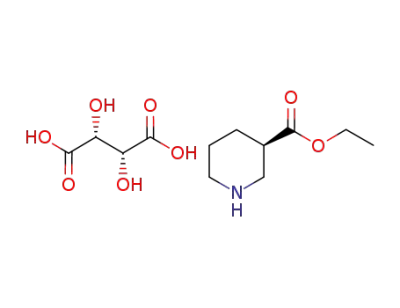
(R)-piperidine-3-carboxylic acid ethyl ester*l-tartaric acid
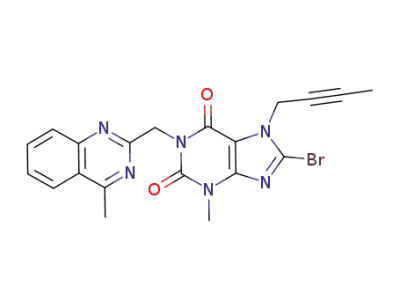
2-bromo-1-(but-2-ynyl)-4-methyl-6-((4-methylquinazolin-2-yl)methyl)-1H-imidazo[4,5-b]pyridine-5,7-(4H,6H)-dione
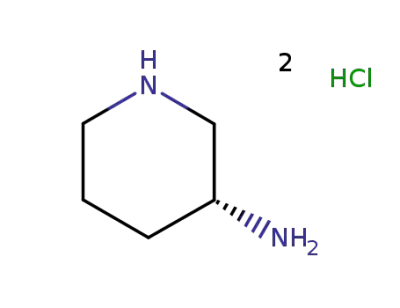
3-(R)-aminopiperidine dihydrochloride